The popular pivot points include PP, and various "support" and "resistance" points based on PP. There are various ways to calculate PP, including the averaging of the High, Low, and Close (H, L, C) of the previous day's trading, or including the Open trading price in the average. Some popular examples[1] follow:
* R4 = PP + RANGE*3
* R3 = PP + RANGE*2
* R2 = PP + RANGE
* R1 = 2 * PP - L
* PP = (H+L+C) / 3
* S1 = 2 * PP - H
* S2: PP - RANGE
* S3: PP - RANGE*2
* S4: PP - RANGE*3
Or
Formula
PP = (H + L + C) / 3
then
* R1 = (2*PP) - L
* R2 = PP + (H - L)
* R3 = H + 2*(PP-L)
* S1 = (2*PP) - H
* S2 = PP - (H - L)
* S3 = L - 2*(H - PP)
Friday, August 28, 2009

Pivot point calculations
Pivot point calculations are used by security traders to attempt to predict support and resistance levels. They are commonly used in the forex and commodity futures markets. Pivot point analysis is a subset of technical analysis, although it is not as popular or well known as other technical methods.
Pivot points are frequently used by foreign exchange traders as a means to calculate resistance and support levels which are, in turn, used as visual cues to execute trades. Pivot point calculations provide traders with objective visual bench marks which some use to predict price changes, although the validity of these levels is still subject to debate.
Pivot points are frequently used by foreign exchange traders as a means to calculate resistance and support levels which are, in turn, used as visual cues to execute trades. Pivot point calculations provide traders with objective visual bench marks which some use to predict price changes, although the validity of these levels is still subject to debate.
History and new developments
Since 1996, when retail forex trading was introduced, several brokers who lacked the sufficient tools developed their own trading platforms tailored specifically to their needs. These platforms were good enough at the time but required constant investments in R&D and its development cost too much. This was the first wave.
The second wave was in the early 2000s: several software companies entered the retail forex trading market by launching their own versions of trading platforms. Typically these versions were cumbersome for both front-end users (retail traders) and back-end users (retail brokers) due to the misunderstanding of the developers about the forex market and also because of the insufficient programming tools/languages at the time. Simultaneously most of the retail brokers kept using and developing their own systems as they waited for better platforms which were yet to be developed.
There are currently few to no brokers which were part of the first wave trading systems. By now most of the first wave brokers have either vanished, merged or progressed to the second wave trading platforms – the most common example of which is Metaquotes.
It is only in the last couple of years that the advanced trading platforms started to emerge. These platforms put much stronger emphasis on the user interface (GUI) making it more accessible to the retail traders while making trading on it very simple and intuitive. Moreover a very strong emphasis was put on the back-end which allowed the retail brokers better control over their operations, better reporting and accurate system and ways to manage marketing campaigns. Gradually this wave is replacing the previous second wave with a major shift now to the friendlier and more intuitive systems of the third wave which according to Aite Group are necessary in order to maintain growth [3].
Nowadays, banks have also jumped on the retail forex trading platform bandwagon and have started offering those services to individual traders and money mangers, expanding the forex trading appeal. DBFX and Citibank are some of the banks that are currently offering this service.
The second wave was in the early 2000s: several software companies entered the retail forex trading market by launching their own versions of trading platforms. Typically these versions were cumbersome for both front-end users (retail traders) and back-end users (retail brokers) due to the misunderstanding of the developers about the forex market and also because of the insufficient programming tools/languages at the time. Simultaneously most of the retail brokers kept using and developing their own systems as they waited for better platforms which were yet to be developed.
There are currently few to no brokers which were part of the first wave trading systems. By now most of the first wave brokers have either vanished, merged or progressed to the second wave trading platforms – the most common example of which is Metaquotes.
It is only in the last couple of years that the advanced trading platforms started to emerge. These platforms put much stronger emphasis on the user interface (GUI) making it more accessible to the retail traders while making trading on it very simple and intuitive. Moreover a very strong emphasis was put on the back-end which allowed the retail brokers better control over their operations, better reporting and accurate system and ways to manage marketing campaigns. Gradually this wave is replacing the previous second wave with a major shift now to the friendlier and more intuitive systems of the third wave which according to Aite Group are necessary in order to maintain growth [3].
Nowadays, banks have also jumped on the retail forex trading platform bandwagon and have started offering those services to individual traders and money mangers, expanding the forex trading appeal. DBFX and Citibank are some of the banks that are currently offering this service.
Retail forex platform
Retail forex trading is a segment of the vast foreign exchange market. It has been speculated that it represents 2 percent of the whole forex market which amounts to $50-60 billion [1][2] in daily trading turnover. Due to the increasing tendency in the past years of the gradual shift from traditional intrabank 'paper' trading to the more advanced and accurate electronic trading, there has been spur in software development in this field. This change provided different types of trading platforms and tools intended for the use by banks, portfolio managers, retail brokers and retail traders.
One of the most important tools required to perform a forex transaction is the trading platform providing retail traders and brokers with accurate currency quotes.
One of the most important tools required to perform a forex transaction is the trading platform providing retail traders and brokers with accurate currency quotes.
Forex Bank
Forex AB is a Swedish financial services company. The company was started in 1927 as a currency exchange service for travellers, at the Central Station in Stockholm. The owner of Gyllenspet's Barber Shop, according to the legend, discovered that most of his customers were tourists in need of currency for their trips. The owner began keeping the major currencies on hand.
The company was subsequently acquired by Statens Järnvägar (SJ), the Swedish State Railways, which expanded the operations until it was sold off to one of the managers, Rolf Friberg, in 1965. The company was the only one apart from the banks that was licensed to conduct currency exchange in Sweden.
The company, which is still wholly owned by the Friberg family, has expanded into Denmark, Finland, Norway and Iceland and has over 60 shops, usually located at train stations or airports. The decrease in the business brought on by introduction of the euro has made the company look for alternative sources of revenue, like applying for a banking licence and attempting to move into more regular transaction services, earlier handled by Svensk Kassaservice, a subsidiary of the state owned Swedish postal company, Posten.
Since 2003 Forex is a licensed bank.
The company was subsequently acquired by Statens Järnvägar (SJ), the Swedish State Railways, which expanded the operations until it was sold off to one of the managers, Rolf Friberg, in 1965. The company was the only one apart from the banks that was licensed to conduct currency exchange in Sweden.
The company, which is still wholly owned by the Friberg family, has expanded into Denmark, Finland, Norway and Iceland and has over 60 shops, usually located at train stations or airports. The decrease in the business brought on by introduction of the euro has made the company look for alternative sources of revenue, like applying for a banking licence and attempting to move into more regular transaction services, earlier handled by Svensk Kassaservice, a subsidiary of the state owned Swedish postal company, Posten.
Since 2003 Forex is a licensed bank.
Successful traders
We at 4exForex.blogspot believe that no advice or a hint can compare to those of real, practising traders with hands-on experience. That's why we decided to start a new section on our site - Successful traders!
Forex4you is going to choose some of the most successful clients, and ask them for interviews! Let great traders share their experiences and wisdom with beginners and newbies, we say!
Our first "Successful trader" is Kase Cheah from Australia. Interview with him is available at the following link:
Successful traders - Kase Cheah, Australia
Forex4you is going to choose some of the most successful clients, and ask them for interviews! Let great traders share their experiences and wisdom with beginners and newbies, we say!
Our first "Successful trader" is Kase Cheah from Australia. Interview with him is available at the following link:
Successful traders - Kase Cheah, Australia
Forex Training
It is necessary to test your knowledge and skills in practice before trading on Forex. A demo-account might be used for that purpose, but it must be kept in mind that it does not reflect the refinements of trade, such as its psychological side.
Until recently there didn't exist other means. Our company was one of the first, who offered beginners a new way of learning Forex by practicing trade skills using real money at minimal risk:
* First of all, deposit currency is US/Euro cents, which allows the use of the same kind of numbers while lowering the cost of deposit by 100 times.
* Secondly, the minimum amount of a transaction is 0.01 (or 1,000 points of a base currency), which significantly lowers the risk of loss.
The "Forex Training" service gives our clients an opportunity to conduct in practice the financial transactions using various strategies at minimal costs, thus overcoming psychological difficulties and helping to predict the likelihood of the success for larger sums.
This service is the result of a long history of foreign exchange market development, beginning with the 100-thousand contracts. For those even the change of 5-10% in six or twelve months is a sufficient profitability level provided by many banks at no risk. Over time, investors felt the need to participate in trading using smaller amounts of money, but at higher level of risk and return.
This has been made possible through leverage. Companies started to offer margin loan services in exchange for certain bonds on an account, which were much smaller than the amount of the transaction. Due to its relevance, this service became popular among investors with relatively small capital. Originally, lots were as much as 100,000 US dollars with a bond of 1,000 or with leverage of 1 to 100 (lot amount is 100 times more than a bond).
fx4u-cent has become a new level in the development of margin loan services. In fx4u-cent the bond is 1,000 times less than a standard contract of 100 thousand (lot 0.1). Many brokers also use the term "micro" for cases with a bond of 10 USD (lot 0.01) but in fact none of them really offers this kind of service.
E-Global Trade & Finance Group, Inc. within the scope of the "Forex Training" program offers a minimal lot of 0.0001 with only 10 cents necessary for a trade at 1 to 100 leverage, thus falling under fx4u-cent conditions. This has become possible due to the adoption of US/Euro cents as a currency. Therefore, having an account of 2,000 cents and conducting a 0.01 lot transaction, a client actually operates with a lot of 0.0001, because the size of the account (US /Eurocents) is 100 times less of a US dollar/Euro account.
fx4u-cent accounts have many advantages as compared to demo or fx4u-micro accounts. Today it is the best way to learn how to trade because it offers practice with real money at risks less than those of other types of accounts. Success in fx4u-cent increases the likelihood of the same results with dollar/Euro accounts.
After training, the customer can evaluate his own work and draw conclusions on what percentage of profitability he achieved by assessing the number and level of depositing in critical situations. At this point he can decide whether he is experienced enough to start working with eGlobal-mini where depositing amounts are greater.
The experience of many traders shows that in most cases, making a deposit in situations of low margin level increases the chances of reaching the break even point. Moreover it creates a decent profit.
E-Global Trade and Finance Group, Inc. offers a wide range of quick and round-the-clock services to make a deposit in critical situations.
We want our clients to learn and make a profit!
We recommend you to start trading on the foreign exchange market with the "Forex Training" service.
The purpose of the competitions, special events and analytical support provided by the Company is to help traders in understanding the beneficial effect of the following factors:
* work with free monetary means;
* the opportunity to edit the account;
* support of analysts and consultants;
* systematic approach in trade with a minimum level of influence of the psychological aspect.
Until recently there didn't exist other means. Our company was one of the first, who offered beginners a new way of learning Forex by practicing trade skills using real money at minimal risk:
* First of all, deposit currency is US/Euro cents, which allows the use of the same kind of numbers while lowering the cost of deposit by 100 times.
* Secondly, the minimum amount of a transaction is 0.01 (or 1,000 points of a base currency), which significantly lowers the risk of loss.
The "Forex Training" service gives our clients an opportunity to conduct in practice the financial transactions using various strategies at minimal costs, thus overcoming psychological difficulties and helping to predict the likelihood of the success for larger sums.
This service is the result of a long history of foreign exchange market development, beginning with the 100-thousand contracts. For those even the change of 5-10% in six or twelve months is a sufficient profitability level provided by many banks at no risk. Over time, investors felt the need to participate in trading using smaller amounts of money, but at higher level of risk and return.
This has been made possible through leverage. Companies started to offer margin loan services in exchange for certain bonds on an account, which were much smaller than the amount of the transaction. Due to its relevance, this service became popular among investors with relatively small capital. Originally, lots were as much as 100,000 US dollars with a bond of 1,000 or with leverage of 1 to 100 (lot amount is 100 times more than a bond).
fx4u-cent has become a new level in the development of margin loan services. In fx4u-cent the bond is 1,000 times less than a standard contract of 100 thousand (lot 0.1). Many brokers also use the term "micro" for cases with a bond of 10 USD (lot 0.01) but in fact none of them really offers this kind of service.
E-Global Trade & Finance Group, Inc. within the scope of the "Forex Training" program offers a minimal lot of 0.0001 with only 10 cents necessary for a trade at 1 to 100 leverage, thus falling under fx4u-cent conditions. This has become possible due to the adoption of US/Euro cents as a currency. Therefore, having an account of 2,000 cents and conducting a 0.01 lot transaction, a client actually operates with a lot of 0.0001, because the size of the account (US /Eurocents) is 100 times less of a US dollar/Euro account.
fx4u-cent accounts have many advantages as compared to demo or fx4u-micro accounts. Today it is the best way to learn how to trade because it offers practice with real money at risks less than those of other types of accounts. Success in fx4u-cent increases the likelihood of the same results with dollar/Euro accounts.
After training, the customer can evaluate his own work and draw conclusions on what percentage of profitability he achieved by assessing the number and level of depositing in critical situations. At this point he can decide whether he is experienced enough to start working with eGlobal-mini where depositing amounts are greater.
The experience of many traders shows that in most cases, making a deposit in situations of low margin level increases the chances of reaching the break even point. Moreover it creates a decent profit.
E-Global Trade and Finance Group, Inc. offers a wide range of quick and round-the-clock services to make a deposit in critical situations.
We want our clients to learn and make a profit!
We recommend you to start trading on the foreign exchange market with the "Forex Training" service.
The purpose of the competitions, special events and analytical support provided by the Company is to help traders in understanding the beneficial effect of the following factors:
* work with free monetary means;
* the opportunity to edit the account;
* support of analysts and consultants;
* systematic approach in trade with a minimum level of influence of the psychological aspect.
Unemployment Rate
The average number of unemployed citizens over 18 years of age relative to the total labor force. Only persons who are registered as unemployed are taken into account. This indicator first appeared in the 1930s in the United States during the Great Depression. A low unemployment rate indicates a large number of citizens employed in the production of goods and services. An increase in unemployment results in lower GDP: employment in the production of goods is lower, hence, production declines. In the United States this data is published along with the"Nonfarm payrolls" at 13:30 GMT. In the Euro zone the data is available in the first decade of each month at 11:00 GMT, and in Japan - in the last decade of each month at 23:50 GMT.
Trade Balance
The ratio of imported and exported goods. The balance is active if the export goods costs exceed the import goods' costs (surplus), otherwise the balance is passive (shortfall). An active balance has a positive effect on the growth rate of the national currency. In the United States, the data is issued in the middle of the month at 13:30 GMT; in Japan - in mid-month at 23:50 GMT; in the Euro zone in the last decade of each month at 11:00 GMT; in Germany - in the first decade of each month at 7:00 GMT; in the UK - in the first decade of each month at 9:30 GMT.
Retail
Changes in retail sales volume, which are determined by consumer demand. In index values the sales of all kinds of goods are taken into account. The most volatile estimate is the sales of automobiles, therefore the most reliable data is calculated without this aspect. The increase in retail sales has an impacton the growth of the national currency rate and on the country's economy as a whole. This data is published in the middle of the month at 13:30 GMT.
Producer Price Index (PPI)
The indicator of the average level of price change for raw materials andfinished products, the cost of which also includes the cost of labor. A more accurate figure is obtained by exclusion of food and energy industries (PPIexcluding food and energy). The index does not take into account the price of imported goods and services. The growth of this indicator leads to the growth of cost inflation: the cost of production increases, while the prices do notchange, which leads to an imbalance in production. Monthly figures issued one week after "Nonfarm payrolls" at 13:30 GMT.
Industrial Production
Industrial output of the country and its changes. It is composed of mining and manufacturing industry volumes, the forest and public sectors as well as the production of electricity are also taken into consideration. The indicator reflects the level of the economy, but does not determine the direction of its development. An increase in value of this indicator leads to the growth of the national currency rate. In the UK and Germany, the data appears in the second decade of each month at 9:30 and 11:00 GMT; in the United States - in mid-month at 14:15; in the Euro zone on the 20th day of each month, at 11:00; in Japan - at the end of the month.
Import
The cost of the volume of imported goods and services for a specific period oftime. Monthly changes in the indicator are generally tracked in percentage and are compared with similar export data. Data on imports is issued during the third week of each month on Thursdays at 13:30 GMT.
Gross Domestic Product (GDP)
The total cost of all goods and services produced by residents and non-residents in the country. The first estimates of GDP were made in the USA. Being an indicator of changes in the cost of goods and services within the country for a certain period, the GDP reflects the growth rate of the economy.The GDP is calculated as the sum of consumption volumes, investments, government spending and exports with imports subtracted. GDP growth characterizes the state of the economy, and the growth in comparison with other countries indicates the benefit of capital investment in the economy of this country. The data is published quarterly in the following order: advance-provisional (revised) - final.
Gold and Foreign Currency Reserves
Country gold and currency reserves held by the Central Bank or Financial bodies. Large reserves of foreign currency and gold represent the level of security and the benefits of investing in the economy of the country.
Export
The value of export goods and services for a specific period of time. Monthly changes of this indicator are generally tracked in percentages and compared with the similar import data. Export data is issued during the third week of each month on Thursdays at 13:30 GMT.
Current Account Balance
The ratio of payments from foreign countries and payments abroad. If the incoming funds exceed the outgoing, the balance is active (surplus), otherwise it is passive (shortfall). An active balance has a positive effect on the growth rate of the national currency. In the United States the data is published quarterly in the middle of the month at 15:00 GMT, in Japan - in the middle of each month at 23:50 GMT; in the Euro zone after the 20th day of each month at 9:00 GMT.
Consumer Price Index (CPI)
Indicator showing the change of value of the consumer basket of goods and services. The index was first calculated in the US. It is calculated using average items chosen by residents. The index has a greater impact on the calculation of the cost of living of citizens and is also an inflation indicator. According to the index rising interest rates begin to rise. Core CPI is the Consumer Price Index excluding food and energy. It serves as an addition to the Consumer Price Index. Core CPI and CPI are issued in the middle of each month at 13:30 GMT.
Consumer Credit
The volume of all types of public credit. The volume of consumer credit varies seasonally and achieves significant growth over major holidays (New Year's Day, Christmas). The increase has a positive impact on the country's economy andleads to an increase in the national currency rate. Consumer credit data is published on the 7th day of every month at 20:00 GMT in the United States and at the end of each month at 9:30 in the UK.
Macroeconomic indicators
World Currencies
Forex Market Participants
Central banks
Forex trading worldwide
Macroeconomic indicators
Glossary
Macroeconomic indicators characterize the level of economic development and indicate either economic growth or a decline. They are also used for price tendency forecasting purposes.
Forex Market Participants
Central banks
Forex trading worldwide
Macroeconomic indicators
Glossary
Macroeconomic indicators characterize the level of economic development and indicate either economic growth or a decline. They are also used for price tendency forecasting purposes.
Forex trading worldwide
While it's absolutely legal to trade forex (currency futures) in most countries allover the world, there still could be specific regulations and terms in particular places. We strongly advise our customers to get familiar with national legislation since we cannot watch after 200+ different law systems.
However, from time to time we will be adding some information in this part of the website. Please don't consider this information a fact, and always cross check with official governmental websites of your country - laws could have changed recently.
However, from time to time we will be adding some information in this part of the website. Please don't consider this information a fact, and always cross check with official governmental websites of your country - laws could have changed recently.
Central banks
Central banks shape the monetary policy and thecredit policy of the country. The main goals of every central bank are tomaintain price stability, to control inflation and to participate on the Forexmarket.
Some of the world's most influential central banks are:
* The Bank of Japan
* The European Central Bank
* The Bank of England
* The US Federal Reserve System
Some of the world's most influential central banks are:
* The Bank of Japan
* The European Central Bank
* The Bank of England
* The US Federal Reserve System
Forex Market Participants
All financial transactions on the market are conducted through a system of institutions: central banks, commercial banks, dealers, brokers. Each Forex participant has a certain trade volume on the currency market. For example, central banks have the largest turnover: their trading volume exceeds hundreds of millions of US dollars a day. Commercial banks and dealers have a much smaller daily turnover. For brokers it is estimated at 25-50 million US dollars, which is only 2% of the total Forex trading volume.
Central banks of the countries of the world
Central banks manage the flow of money and credit using certain instruments, as defined by law. Central bank key functions are money emission, monetary and foreign exchange policy, etc. For instance, the central bank's exchange market intervention may reduce or increase the rate of the national currency.
Commercial banks
Commercial banks are financial institutions, which have the right to take deposits from individuals and entities, to place money in their interests with an obligation to pay the owner back, and to open and maintain bank accounts. In every country there are several large commercial banks that can influence exchange rates. In 2006, Deutsche Bank turnover was 19.26% of the Forex turnover.
Brokers
A broker is a legal entity or an individual who works as a mediator and facilitates foreign currency transactions, linking the seller of goods, securities or currencies with the buyer. A broker works on behalf of a customer and at his expense and can provide additional customer services. A broker receives a commission for executing customer orders.
Dealers
Dealers are companies or individuals operating in the market at their own expense and on their own behalf, which are engaged in the sale of currency and other assets.
Central banks of the countries of the world
Central banks manage the flow of money and credit using certain instruments, as defined by law. Central bank key functions are money emission, monetary and foreign exchange policy, etc. For instance, the central bank's exchange market intervention may reduce or increase the rate of the national currency.
Commercial banks
Commercial banks are financial institutions, which have the right to take deposits from individuals and entities, to place money in their interests with an obligation to pay the owner back, and to open and maintain bank accounts. In every country there are several large commercial banks that can influence exchange rates. In 2006, Deutsche Bank turnover was 19.26% of the Forex turnover.
Brokers
A broker is a legal entity or an individual who works as a mediator and facilitates foreign currency transactions, linking the seller of goods, securities or currencies with the buyer. A broker works on behalf of a customer and at his expense and can provide additional customer services. A broker receives a commission for executing customer orders.
Dealers
Dealers are companies or individuals operating in the market at their own expense and on their own behalf, which are engaged in the sale of currency and other assets.
World Currencies
Concept of currency:
1. country's monetary unit and its type (golden, silver, paper);
2. foreign countries banknotes as well as credit and payment instruments expressed in foreign monetary units (bills of exchange, cheques etc.) and used in international payments.
Currency types:
* fully convertible currency has no restrictions on any financial transactions for both residents as well as non-residents and may be exchanged for any foreign currency (the US dollar, Canadian dollar, Swiss franc, etc.);
* partially convertible currency has restrictions on certain foreign exchange transactionsas well as restrictions for non-residents. Partially convertible currencies are those of the majority of Western European countries (Great Britain, France, Italy, Belgium, the Netherlands, Sweden, Denmark, Norway, Finland and Austria). After abolishing in December 1958 foreign exchange restrictions for non-residents, it became possible for them to convert any amount of money in bank accounts into US dollars or other currencies;
* inconvertible (weak) currency has restrictions on currency transactions for residents as well as for non-residents. This group consists of currencies of dependent and developing countries, which are pegged to the parent states? currencies. Weak currencies rates are set at levels profitable for foreign monopolies.
1. country's monetary unit and its type (golden, silver, paper);
2. foreign countries banknotes as well as credit and payment instruments expressed in foreign monetary units (bills of exchange, cheques etc.) and used in international payments.
Currency types:
* fully convertible currency has no restrictions on any financial transactions for both residents as well as non-residents and may be exchanged for any foreign currency (the US dollar, Canadian dollar, Swiss franc, etc.);
* partially convertible currency has restrictions on certain foreign exchange transactionsas well as restrictions for non-residents. Partially convertible currencies are those of the majority of Western European countries (Great Britain, France, Italy, Belgium, the Netherlands, Sweden, Denmark, Norway, Finland and Austria). After abolishing in December 1958 foreign exchange restrictions for non-residents, it became possible for them to convert any amount of money in bank accounts into US dollars or other currencies;
* inconvertible (weak) currency has restrictions on currency transactions for residents as well as for non-residents. This group consists of currencies of dependent and developing countries, which are pegged to the parent states? currencies. Weak currencies rates are set at levels profitable for foreign monopolies.
World Currencies
Concept of currency:
1. country's monetary unit and its type (golden, silver, paper);
2. foreign countries banknotes as well as credit and payment instruments expressed in foreign monetary units (bills of exchange, cheques etc.) and used in international payments.
Currency types:
* fully convertible currency has no restrictions on any financial transactions for both residents as well as non-residents and may be exchanged for any foreign currency (the US dollar, Canadian dollar, Swiss franc, etc.);
* partially convertible currency has restrictions on certain foreign exchange transactionsas well as restrictions for non-residents. Partially convertible currencies are those of the majority of Western European countries (Great Britain, France, Italy, Belgium, the Netherlands, Sweden, Denmark, Norway, Finland and Austria). After abolishing in December 1958 foreign exchange restrictions for non-residents, it became possible for them to convert any amount of money in bank accounts into US dollars or other currencies;
* inconvertible (weak) currency has restrictions on currency transactions for residents as well as for non-residents. This group consists of currencies of dependent and developing countries, which are pegged to the parent states? currencies. Weak currencies rates are set at levels profitable for foreign monopolies.
1. country's monetary unit and its type (golden, silver, paper);
2. foreign countries banknotes as well as credit and payment instruments expressed in foreign monetary units (bills of exchange, cheques etc.) and used in international payments.
Currency types:
* fully convertible currency has no restrictions on any financial transactions for both residents as well as non-residents and may be exchanged for any foreign currency (the US dollar, Canadian dollar, Swiss franc, etc.);
* partially convertible currency has restrictions on certain foreign exchange transactionsas well as restrictions for non-residents. Partially convertible currencies are those of the majority of Western European countries (Great Britain, France, Italy, Belgium, the Netherlands, Sweden, Denmark, Norway, Finland and Austria). After abolishing in December 1958 foreign exchange restrictions for non-residents, it became possible for them to convert any amount of money in bank accounts into US dollars or other currencies;
* inconvertible (weak) currency has restrictions on currency transactions for residents as well as for non-residents. This group consists of currencies of dependent and developing countries, which are pegged to the parent states? currencies. Weak currencies rates are set at levels profitable for foreign monopolies.
Forex volumes
Forex is the world biggest financial market. In April 2004, average daily volume used to be 1.9 trillion US dollars, which is higher than:
* eleven average volumes of all world stock exchanges together (167 billion US dollars);
* forty average volumes of NYSE - biggest stock exchange in the world (46 billion US dollars);
* 300 US dollars every day for every world citizen.
By April 2007, average daily volume increased to 3.2 trillion US dollars (~70% higher than in April 2004).
Most important markets: USA, United Kingdom and Japan. More than half of Forex volume is done in the UK and USA. Highest activity is detected in period of different markets' working hours interference
* eleven average volumes of all world stock exchanges together (167 billion US dollars);
* forty average volumes of NYSE - biggest stock exchange in the world (46 billion US dollars);
* 300 US dollars every day for every world citizen.
By April 2007, average daily volume increased to 3.2 trillion US dollars (~70% higher than in April 2004).
Most important markets: USA, United Kingdom and Japan. More than half of Forex volume is done in the UK and USA. Highest activity is detected in period of different markets' working hours interference
Forex history
In 1967, a Chicago bank refused a college professor by the name of Milton Friedman a loan in pound sterling because he had intended to use the funds to short the British currency. Friedman, ho had perceived sterling to be priced too high against the dollar, wanted to sell the currency, then later buy it back to repay the bank after the currency declined, thus pocketing a quick profit. The bank's refusal to grant the loan was due to the Bretton Woods Agreement, established twenty years earlier, which fixed national currencies against the dollar, and set the dollar at a rate of per ounce of gold.
The Bretton Woods Agreement, set up in 1944, aimed at installing international monetary stability by preventing money from fleeing across nations, and restricting speculation in the world currencies Prior to the Agreement, the gold exchange standard--prevailing between 1876 and World War I--dominated the international economic system. Under the gold. exchange, currencies gained a new phase of stability as they were backed by the price of gold. It abolished the age-old practice used by kings and rulers of arbitrarily debasing money and triggering inflation. But the gold exchange standard didn't lack faults. As an economy strengthened, it would import heavily from abroad until it ran down its gold reserves required to back its money. As a result, money supply would shrink, interest rates rose and economic activity slowed to the extent of recession. Ultimately, prices of goods had hit bottom, appearing attractive to other nations, which would rush into buying sprees that injected the economy with gold until it increased its money supply, and drive down interest rates and recreate wealth into the economy. Such boom-bust patterns prevailed throughout the gold standard until the outbreak of World War I interrupted trade flows and the free movement of gold.
After the Wars, the Bretton Woods Agreement was founded, where participating countries agreed to try and maintain the value of their currency with a narrow margin against the dollar and a corresponding rate of gold as needed. Countries were prohibited from devaluing their currencies to their trade advantage and were only allowed to do so for devaluations of less than 10%. Into the 1950s, the ever-expanding volume of international trade led to massive movements of capital generated by post-war construction. That destabilized foreign exchange rates as set up in Bretton Woods.
The Agreement was finally abandoned in 1971, and the US dollar would no longer be convertible into gold. By 1973, currencies of major industrialized nations became more freely floating, controlled mainly by the forces of supply and demand which acted in the foreign exchange market. Prices were floated daily, with volumes, speed and price volatility all increasing throughout the 1970s, giving rise to new financial instruments, market deregulation and trade liberalization.
In the 1980s, cross-border capital movements accelerated with the advent of computers and technology, extending market continuum through Asian, European and American time zones. Transactions in foreign exchange rocketed from about billion a day in the 1980s, to more than .5 trillion a day two decades later.
The Bretton Woods Agreement, set up in 1944, aimed at installing international monetary stability by preventing money from fleeing across nations, and restricting speculation in the world currencies Prior to the Agreement, the gold exchange standard--prevailing between 1876 and World War I--dominated the international economic system. Under the gold. exchange, currencies gained a new phase of stability as they were backed by the price of gold. It abolished the age-old practice used by kings and rulers of arbitrarily debasing money and triggering inflation. But the gold exchange standard didn't lack faults. As an economy strengthened, it would import heavily from abroad until it ran down its gold reserves required to back its money. As a result, money supply would shrink, interest rates rose and economic activity slowed to the extent of recession. Ultimately, prices of goods had hit bottom, appearing attractive to other nations, which would rush into buying sprees that injected the economy with gold until it increased its money supply, and drive down interest rates and recreate wealth into the economy. Such boom-bust patterns prevailed throughout the gold standard until the outbreak of World War I interrupted trade flows and the free movement of gold.
After the Wars, the Bretton Woods Agreement was founded, where participating countries agreed to try and maintain the value of their currency with a narrow margin against the dollar and a corresponding rate of gold as needed. Countries were prohibited from devaluing their currencies to their trade advantage and were only allowed to do so for devaluations of less than 10%. Into the 1950s, the ever-expanding volume of international trade led to massive movements of capital generated by post-war construction. That destabilized foreign exchange rates as set up in Bretton Woods.
The Agreement was finally abandoned in 1971, and the US dollar would no longer be convertible into gold. By 1973, currencies of major industrialized nations became more freely floating, controlled mainly by the forces of supply and demand which acted in the foreign exchange market. Prices were floated daily, with volumes, speed and price volatility all increasing throughout the 1970s, giving rise to new financial instruments, market deregulation and trade liberalization.
In the 1980s, cross-border capital movements accelerated with the advent of computers and technology, extending market continuum through Asian, European and American time zones. Transactions in foreign exchange rocketed from about billion a day in the 1980s, to more than .5 trillion a day two decades later.
How do I trade on Forex?
For starters, you simply choose which two currencies you want to make a deal with on Forex. You choose the amount of the deal you'd like to make (called the "volume"). You make a deposit to provide the collateral needed for the deal, called the "margin." In most cases, this is just a fraction of the overall amount of the deal? for example, 1%, or 1:100.
You still have the power to "freeze" the deal for several seconds before you finalize it. Freezing allows you to adjust the terms or to accept them as they are. Or, you can call the whole thing off, and cancel the deal. Freezing is a feature offered exclusively by E-Global Trade & Finance Group, Inc. While your deal is still running, you have a so-called "open position." This means that you're able to follow your deal's status and scenarios online at any time. You can make changes to the deal's terms, or you can simply cancel it and either pocket any profits, or minimize any losses. What's more, E-Global Trade & Finance Group, Inc. allows you to set a "take-profit" rate. When and if the market reaches this rate, your deal will close automatically, allowing you to be away from your computer while you have an "open position."
Ready to learn more, or find additional training online. Just register with us, with no obligation, and we will lead you through the process step-by-step.
You still have the power to "freeze" the deal for several seconds before you finalize it. Freezing allows you to adjust the terms or to accept them as they are. Or, you can call the whole thing off, and cancel the deal. Freezing is a feature offered exclusively by E-Global Trade & Finance Group, Inc. While your deal is still running, you have a so-called "open position." This means that you're able to follow your deal's status and scenarios online at any time. You can make changes to the deal's terms, or you can simply cancel it and either pocket any profits, or minimize any losses. What's more, E-Global Trade & Finance Group, Inc. allows you to set a "take-profit" rate. When and if the market reaches this rate, your deal will close automatically, allowing you to be away from your computer while you have an "open position."
Ready to learn more, or find additional training online. Just register with us, with no obligation, and we will lead you through the process step-by-step.
How do I turn a profit using Forex?
Again, the answer is obvious: just as with any market, you make money by buying low and selling high! Buy for less, sell for more! All you do is take advantages of fluctuations in the relative values of world currencies. Each currency's value changes every day in the currency exchange market. All you have to do is use these fluctuations to your advantage.
One thing we'd like to mention about currency exchange on Forex: on Forex, these daily fluctuations are actually 100 times greater than the actual fluctuation (for example, around 1%). Generally speaking, E-Global Trade & Finance Group, Inc. can offer trading ratios of between 1:10, 1:100, 1:200 and 1:500. So let's do the math: if the exchange rate of your given pair of currencies increased by just 0.6% over the last few hours, then you'll bag a profit of 60% on your original investment! All of this can happen over the course of a single business day, or as quickly as a matter of minutes.
And best of all, you don't risk losing anything more than your margin! There's absolutely no limit to your possible profits, but you never risk losing anything beyond what you originally invested.
And another thing: you have the power to choose your pair of currencies, and their amount, based on which way the market's headed, and still turn a profit. It makes no difference which way the exchange rate is headed, down or up, because you always have the choice of buying US dollars and selling Yen, or the other way around - buy Yen and sell US dollars. And no, you don't need to actually own any particular currencies, or "have" them in hand, in order to make transactions with them on Forex (to buy them or sell them).
So, just how do I get started?
You simply register with E-Global Trade & Finance Group, Inc. we offer the easiest and fastest registration out there, with absolutely no obligations. Once you're registered, just make a deposit of the margin amount you choose to begin trading with, and you begin trading on Forex. And only E-Global Trade & Finance Group, Inc. allows you to make your deposit with your credit card.
It just doesn't get any simpler. But if you do need assistance, we offer as much customer service and one-on-one training as you need. And with E-Global Trade & Finance Group, Inc., your help won't come from a computer, but from a living, breathing human being, who speaks your language.
One thing we'd like to mention about currency exchange on Forex: on Forex, these daily fluctuations are actually 100 times greater than the actual fluctuation (for example, around 1%). Generally speaking, E-Global Trade & Finance Group, Inc. can offer trading ratios of between 1:10, 1:100, 1:200 and 1:500. So let's do the math: if the exchange rate of your given pair of currencies increased by just 0.6% over the last few hours, then you'll bag a profit of 60% on your original investment! All of this can happen over the course of a single business day, or as quickly as a matter of minutes.
And best of all, you don't risk losing anything more than your margin! There's absolutely no limit to your possible profits, but you never risk losing anything beyond what you originally invested.
And another thing: you have the power to choose your pair of currencies, and their amount, based on which way the market's headed, and still turn a profit. It makes no difference which way the exchange rate is headed, down or up, because you always have the choice of buying US dollars and selling Yen, or the other way around - buy Yen and sell US dollars. And no, you don't need to actually own any particular currencies, or "have" them in hand, in order to make transactions with them on Forex (to buy them or sell them).
So, just how do I get started?
You simply register with E-Global Trade & Finance Group, Inc. we offer the easiest and fastest registration out there, with absolutely no obligations. Once you're registered, just make a deposit of the margin amount you choose to begin trading with, and you begin trading on Forex. And only E-Global Trade & Finance Group, Inc. allows you to make your deposit with your credit card.
It just doesn't get any simpler. But if you do need assistance, we offer as much customer service and one-on-one training as you need. And with E-Global Trade & Finance Group, Inc., your help won't come from a computer, but from a living, breathing human being, who speaks your language.
So what exactly is Forex, you ask?
More precisely, FOREX is a currency trading market, and it's one of the largest and most rapidly developing markets on the planet. Over 2.5 trillion dollars are turned over on Forex every single day. That's more than 100 times more than the amount turned over daily on NASDAQ. If you're intrigued, you can click here and get more detailed market information from E-Global Trade & Finance Group, Inc.
So, what's a market? Simple: it's a place where goods are traded. Forex is no different, but with one little twist: the goods traded on Forex are the national currencies of the world's countries. For example, on Forex you might pay in American dollars and buy some Canadian dollars. Or, you could sell your Euros for Japanese Yen. There's nothing more to it than that.
So, what's a market? Simple: it's a place where goods are traded. Forex is no different, but with one little twist: the goods traded on Forex are the national currencies of the world's countries. For example, on Forex you might pay in American dollars and buy some Canadian dollars. Or, you could sell your Euros for Japanese Yen. There's nothing more to it than that.
How to earn money with Forex
Since it might be a bit complicated for a beginner to figure out how to make money in Forex, we offer you this example:
You believe that the Euro to US Dollar (EURUSD) rate will increase. In your account you have 2000 USD (eGlobal-standard). At a price of 1.2750 you buy 150,000 Euro for 150,000*1.2750 = 191,250 USD.
This is possible because of the credit, which allows you to make transactions worth 100 times more than funds you have in your account (in this specific case, the maximum sum available for transactions is 2000*100 = 200,000 USD).
After a period of time, the exchange rate increases. You sell 150,000 Euro at the rate of 1.2850 and get 150,000*1.2850 = 192,750 USD.
Thus, after buying at a low rate and selling at a high rate, the difference 192,750 - 191,250 = 1500 $ is your gain. You have earned 75% of initial funds in your account, while the rate increased by 0.8%.

Another way of making a profit on Forex is based on the decrease of the quotation rate of the EURUSD currency pair:
Having created a real account with 200 USD in it (eGlobal-mini), you determine the upper and lower limits on the Euro to Dollar chart and sell 15,000 Euro (0.15 lot) at the upper limit for a price of 1.2850 (bid price) USD for 1 Euro, which equals 19,275 USD (15,000 Euro multiplied by the rate of 1.2850).
You have funds in USD in your account, but you can sell Euro using the automatic borrowing system. Hence, the company lends you 15,000 Euro free of charge, which you can sell by sending a selling request. Due to the leverage, the actual deposit is 100 times less than the sum sold: 15,000/100 = 150 euro. At a rate of 1.2850 this equals 192,75 USD. This very sum is going to be a deposit for a credit (marginal) transaction for your account. The maximum possible deposit in this case equals 200 USD.
Then during the day the price drops to the lower limit and you decide to buy 15,000 Euro at a price of 1.2750 (ask price) USD for 1 Euro, which equals 19,125 USD. The 15,000 Euro that you have bought are written off your account towards the repayment of the company loan, while the difference is left in your account.
Thus, due to the fall in the exchange rate you earn the difference between sold and bought, which is 19,275 - 19,125 = 150 USD. You managed to earn 75% (150 dollars) of your initial sum of 200 USD due to a rate decrease by 0.8% (from 1.2850 to 1.2750) in only one day.
The company takes a commission in the form of the difference between the ask and bid prices or spread, which in this example is 3 USD (spread of EuroDollar pair equals 0.0002 or 2 pips). More detailed information on terminology is in the Glossary.
In these examples, the spread is not taken into consideration while calculating percentages of rate changes because of its non-essential influence on the results. In the case of mircoForex or eGlobal-standard the calculations are similar with a difference only in account currency US cents for micro, USD for mini & standard. The consecutive use of the transactions shown gives the income of 75%+75% = 150%. In actual practice a much greater return may be achieved by using corresponding money management methods. Risk management methods also play an important role in trade
You believe that the Euro to US Dollar (EURUSD) rate will increase. In your account you have 2000 USD (eGlobal-standard). At a price of 1.2750 you buy 150,000 Euro for 150,000*1.2750 = 191,250 USD.
This is possible because of the credit, which allows you to make transactions worth 100 times more than funds you have in your account (in this specific case, the maximum sum available for transactions is 2000*100 = 200,000 USD).
After a period of time, the exchange rate increases. You sell 150,000 Euro at the rate of 1.2850 and get 150,000*1.2850 = 192,750 USD.
Thus, after buying at a low rate and selling at a high rate, the difference 192,750 - 191,250 = 1500 $ is your gain. You have earned 75% of initial funds in your account, while the rate increased by 0.8%.
Another way of making a profit on Forex is based on the decrease of the quotation rate of the EURUSD currency pair:
Having created a real account with 200 USD in it (eGlobal-mini), you determine the upper and lower limits on the Euro to Dollar chart and sell 15,000 Euro (0.15 lot) at the upper limit for a price of 1.2850 (bid price) USD for 1 Euro, which equals 19,275 USD (15,000 Euro multiplied by the rate of 1.2850).
You have funds in USD in your account, but you can sell Euro using the automatic borrowing system. Hence, the company lends you 15,000 Euro free of charge, which you can sell by sending a selling request. Due to the leverage, the actual deposit is 100 times less than the sum sold: 15,000/100 = 150 euro. At a rate of 1.2850 this equals 192,75 USD. This very sum is going to be a deposit for a credit (marginal) transaction for your account. The maximum possible deposit in this case equals 200 USD.
Then during the day the price drops to the lower limit and you decide to buy 15,000 Euro at a price of 1.2750 (ask price) USD for 1 Euro, which equals 19,125 USD. The 15,000 Euro that you have bought are written off your account towards the repayment of the company loan, while the difference is left in your account.
Thus, due to the fall in the exchange rate you earn the difference between sold and bought, which is 19,275 - 19,125 = 150 USD. You managed to earn 75% (150 dollars) of your initial sum of 200 USD due to a rate decrease by 0.8% (from 1.2850 to 1.2750) in only one day.
The company takes a commission in the form of the difference between the ask and bid prices or spread, which in this example is 3 USD (spread of EuroDollar pair equals 0.0002 or 2 pips). More detailed information on terminology is in the Glossary.
In these examples, the spread is not taken into consideration while calculating percentages of rate changes because of its non-essential influence on the results. In the case of mircoForex or eGlobal-standard the calculations are similar with a difference only in account currency US cents for micro, USD for mini & standard. The consecutive use of the transactions shown gives the income of 75%+75% = 150%. In actual practice a much greater return may be achieved by using corresponding money management methods. Risk management methods also play an important role in trade
How to double initial capital with forex trading
Let's say exchange rate has changed 1% throughout the day. How to earn 100% in this situation, or in other words - how to double the capital? Well, that's simple! Our dealing center provides "free credit" (leverage) that could be 99 times bigger than your initial capital, so you can put an order for the amount of 100 your initial capitals - so you get 100 times more opportunities in Forex to make profits on little exchange rate fluctuations. You can even choose 1:500 leverage and receive even more opportunities! In order to achieve success in Forex market, you have to predict exchange rate changes...
Pricing
The relationship between spot and forward is as follows:
F = S \left( \frac{1+r_1}{1+r_2}\right)^T
where:
* F = forward rate
* S = spot rate
* r1 = simple interest rate of the term currency
* r2 = simple interest rate of the base currency
* T = tenor (calculated according to the appropriate day count convention)
The forward points or swap points are quoted as the difference between forward and spot, F - S, and is expressed as the following:
F - S = S \left[ \left(\frac{1+r_1}{1+r_2}\right)^T -1 \right] \approx S \left( e^\left(\left(r_1 - r_2\right)T\right) - 1\right)
where r1 and r2 are small. Thus, the absolute value of the swap points increases when the interest rate differential gets larger, and vice versa.
F = S \left( \frac{1+r_1}{1+r_2}\right)^T
where:
* F = forward rate
* S = spot rate
* r1 = simple interest rate of the term currency
* r2 = simple interest rate of the base currency
* T = tenor (calculated according to the appropriate day count convention)
The forward points or swap points are quoted as the difference between forward and spot, F - S, and is expressed as the following:
F - S = S \left[ \left(\frac{1+r_1}{1+r_2}\right)^T -1 \right] \approx S \left( e^\left(\left(r_1 - r_2\right)T\right) - 1\right)
where r1 and r2 are small. Thus, the absolute value of the swap points increases when the interest rate differential gets larger, and vice versa.
Forex swap
In finance, a forex swap (or FX swap) is a simultaneous purchase and sale of identical amounts of one currency for another with two different value dates (normally spot to forward)
A forex swap consists of two legs:
* a spot foreign exchange transaction, and
* a forward foreign exchange transaction.
These two legs are executed simultaneously for the same quantity, and therefore offset each other.
It is also common to trade forward-forward, where both transactions are for (different) forward dates.
By far and away the most common use of FX swaps is for institutions to fund their foreign exchange balances.
Once a foreign exchange transaction settles, the holder is left with a positive (or long) position in one currency, and a negative (or short) position in another. In order to collect or pay any overnight interest due on these foreign balances, at the end of every day institutions will close out any foreign balances and re-institute them for the following day. To do this they typically use tom-next swaps, buying (selling) a foreign amount settling tomorrow, and selling (buying) it back settling the day after.
The interest collected or paid every night is referred to as the cost of carry. As currency traders know roughly how much holding a currency position will make or cost on a daily basis, specific trades are put on based on this; these are referred to as carry trades.
A forex swap consists of two legs:
* a spot foreign exchange transaction, and
* a forward foreign exchange transaction.
These two legs are executed simultaneously for the same quantity, and therefore offset each other.
It is also common to trade forward-forward, where both transactions are for (different) forward dates.
By far and away the most common use of FX swaps is for institutions to fund their foreign exchange balances.
Once a foreign exchange transaction settles, the holder is left with a positive (or long) position in one currency, and a negative (or short) position in another. In order to collect or pay any overnight interest due on these foreign balances, at the end of every day institutions will close out any foreign balances and re-institute them for the following day. To do this they typically use tom-next swaps, buying (selling) a foreign amount settling tomorrow, and selling (buying) it back settling the day after.
The interest collected or paid every night is referred to as the cost of carry. As currency traders know roughly how much holding a currency position will make or cost on a daily basis, specific trades are put on based on this; these are referred to as carry trades.
Foreign exchange reserves

Foreign exchange reserves (also called Forex reserves) in a strict sense are only the foreign currency deposits and bonds held by central banks and monetary authorities. However, the term in popular usage commonly includes foreign exchange and gold, SDRs and IMF reserve positions. This broader figure is more readily available, but it is more accurately termed official international reserves or international reserves. These are assets of the central bank held in different reserve currencies, mostly the US dollar, and to a lesser extent the euro, the UK pound, and the Japanese yen, and used to back its liabilities, e.g. the local currency issued, and the various bank reserves deposited with the central bank, by the government or financial institutions.
Forex exchange market
The foreign exchange market (currency, forex, or FX) trades currencies. It lets banks and other institutions easily buy and sell currencies.
The purpose of the foreign exchange market is to help international trade and investment. A foreign exchange market helps businesses convert one currency to another. For example, it permits a U.S. business to import European goods and pay Euros, even though the business's income is in U.S. dollars.
In a typical foreign exchange transaction a party purchases a quantity of one currency by paying a quantity of another currency. The modern foreign exchange market started forming during the 1970s when countries gradually switched to floating exchange rates from the previous exchange rate regime, which remained fixed as per the Bretton Woods system.
The foreign exchange market is unique because of
* its trading volumes,
* the extreme liquidity of the market,
* its geographical dispersion,
* its long trading hours: 24 hours a day except on weekends (from 22:00 UTC on Sunday until 22:00 UTC Friday),
* the variety of factors that affect exchange rates.
* the low margins of profit compared with other markets of fixed income (but profits can be high due to very large trading volumes)
* the use of leverage
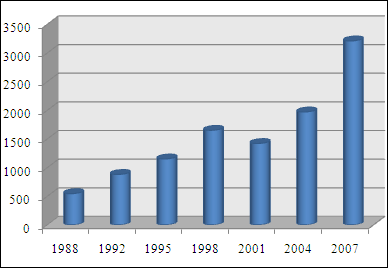
Main foreign exchange market turnover, 1988 - 2007, measured in billions of USD.
As such, it has been referred to as the market closest to the ideal perfect competition, notwithstanding market manipulation by central banks. According to the Bank for International Settlements,[2] average daily turnover in global foreign exchange markets is estimated at $3.98 trillion. Trading in the world's main financial markets accounted for $3.21 trillion of this. This approximately $3.21 trillion in main foreign exchange market turnover was broken down as follows:
* $1.005 trillion in spot transactions
* $362 billion in outright forwards
* $1.714 trillion in foreign exchange swaps
* $129 billion estimated gaps in reporting
